
Recently, the American Marketing Association St. Louis Chapter asked me to speak on a panel about marketing planning—specifically, how I build marketing plans for my agency and our clients.
I realized my perspective on marketing planning doesn’t always line up neatly with the way it’s usually discussed.
Not because there is a wrong way, but because a lot of marketing planning lives at a theoretical level, while my experience has been shaped by plans that have to survive real constraints: limited budgets, internal politics, shifting priorities and clients who need clarity more than complexity.
So I thought I’d unpack some of my thinking here. This info has taken years of learning and decades of working with different types of clients to figure out, and I’m happy to share what I know and the lessons that got me here.
Starting with the most important one:
There is no “one right way” to plan your marketing.
The first thing you should know about creating a marketing plan is that there isn’t a single “right way” of building one.
Marketing experts, authors, MBAs and entrepreneurs all tend to have their preferred methods to building a marketing plan—and often like to argue that their way is the best way.
Countless books and degrees have been sold in the process. Businesses tend to prefer a marketing plan that fits their own culture and processes.
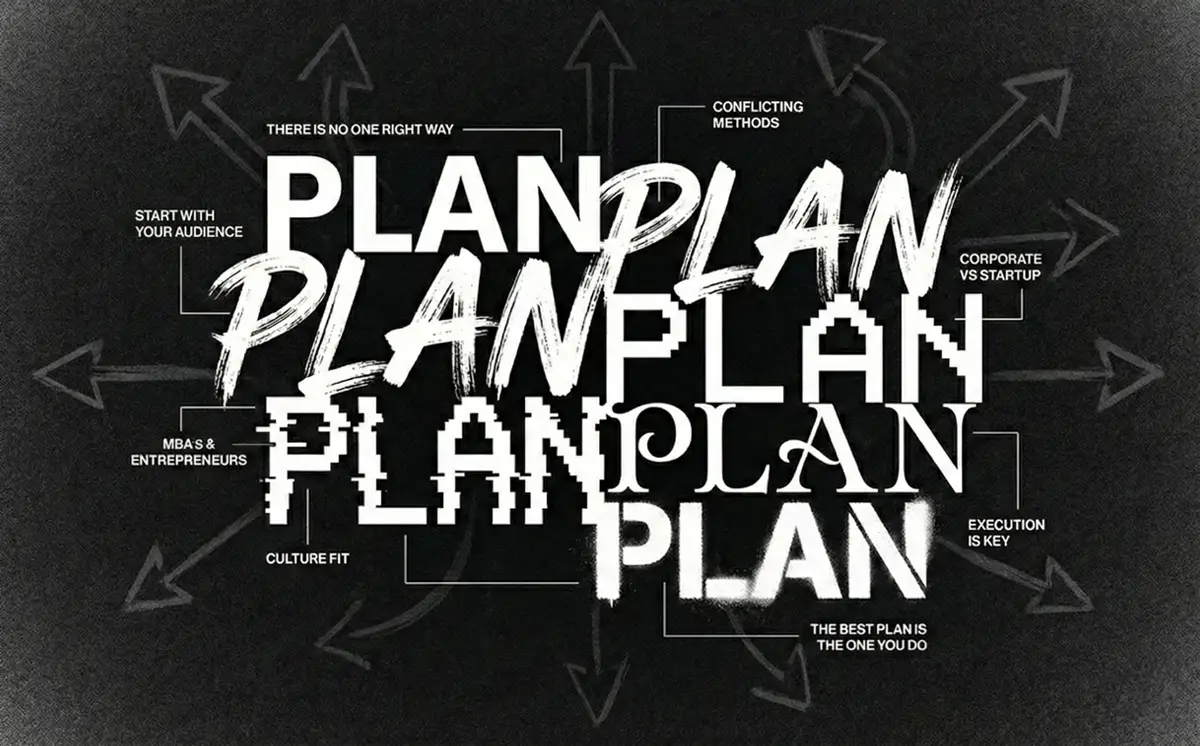
One-pager strategy docs. 200-slide decks. Gantt charts. Multi-tabbed spreadsheets. Any of them can work—the format isn’t what matters.
The important part is to remember what my neighbor says about exercise: “The best workout is the one you actually do.”
In other words, the best marketing plan is the one you actually execute. Not a document that a lot of effort went into that lives buried in your inbox, never to see the light of day.
Marketing plans have to be useful, and in order to do that, they need to be true to your business’ culture. The table below compares three pretty different marketing planning methods: the traditional corporate method, the 1-page marketing plan (like the one outlined in Allan Dib’s book of the same name) and AC/DC and tacking (two Mike Michalowicz’s strategies).
They’re pretty drastically different approaches, all with the same aim: creating a plan that grows a business.
| Category | Traditional Corporate | 1-Page Marketing Plan (Allan Dib) | AC/DC + Tacking (Mike Michalowicz) |
|---|---|---|---|
| Core philosophy | Predict, control, align everyone around a detailed annual plan. | Simplicity beats complexity; a plan you can see on one page is a plan you’ll actually use. | Business is a flow (Attract, Convert, Deliver, Collect); keep fixing the weakest link with small experiments. |
| Format | 30–50 slide deck, supporting spreadsheets, PM tool full of initiatives. | 1 sheet with 9 boxes covering Before, During, After. | A simple canvas or whiteboard: AC/DC across the top, with quarterly tests under each. |
| Starting point | Revenue targets, product roadmap, GTM motions, leadership themes, budget. | Target market → message → media, then nurture / convert and retention / referrals. | “Where are we breaking AC/DC?” (Not enough leads? Weak close rate? Delivery chaos? Cash slow?) |
| How goals are set | Top-down: leadership sets annual goals, marketing backs into campaigns and channels. | Customer-centric: choose a niche and outcome, then design everything to get and keep those customers. | Constraint-centric: choose the most broken part of the flow and set goals to improve that this quarter. |
| Planning horizon | 12 months, often locked; mid-year changes feel painful. | 12-month view, but easy to tweak as you learn — it’s meant to be updated. | 90-day cycles; annual direction is loose, course corrected constantly (“tacking”). |
| Budget mindset | Allocate by channel and campaign upfront; hitting the plan = sticking to the numbers. | Spend where the 9-box plan says the leverage is; track ROI per step of the journey. | Keep a flexible “experiment fund” to test AC/DC fixes; double down on what works, cut what doesn’t. |
| Culture fit | Great for big teams, with cross-functional alignment, documentation, governance. | Great for founders/SMBs and scrappy B2B teams who need clarity without bureaucracy. | Great for entrepreneurial, expert-driven firms (like Atomicdust clients) that value learning and adaptability. |
| Risk / downside | Beautiful plan, low agility; can become “a document that lives in SharePoint and no one reads.” | Looks too simple for some; can be ignored if leadership secretly craves complexity. | Can feel “too loose” to corporate types; relies on discipline in reviewing the data and actually tacking. |
I’ve seen each of these methods work. From corporate to casual, each can be just as impactful to a business and yield the same outcomes. It’s just your preference on the approach that works best for your business’ culture.
None of these methods guarantees success alone, because marketing isn’t based purely on planning. It’s worth repeating: marketing isn’t a plan. Marketing is messaging and frequency. And the messaging (what you’ll say to attract clients and convert them to sales) is the magic of it.
All of these methods fall apart without having a message that the customer cares about.
So how do you make sure you have that?
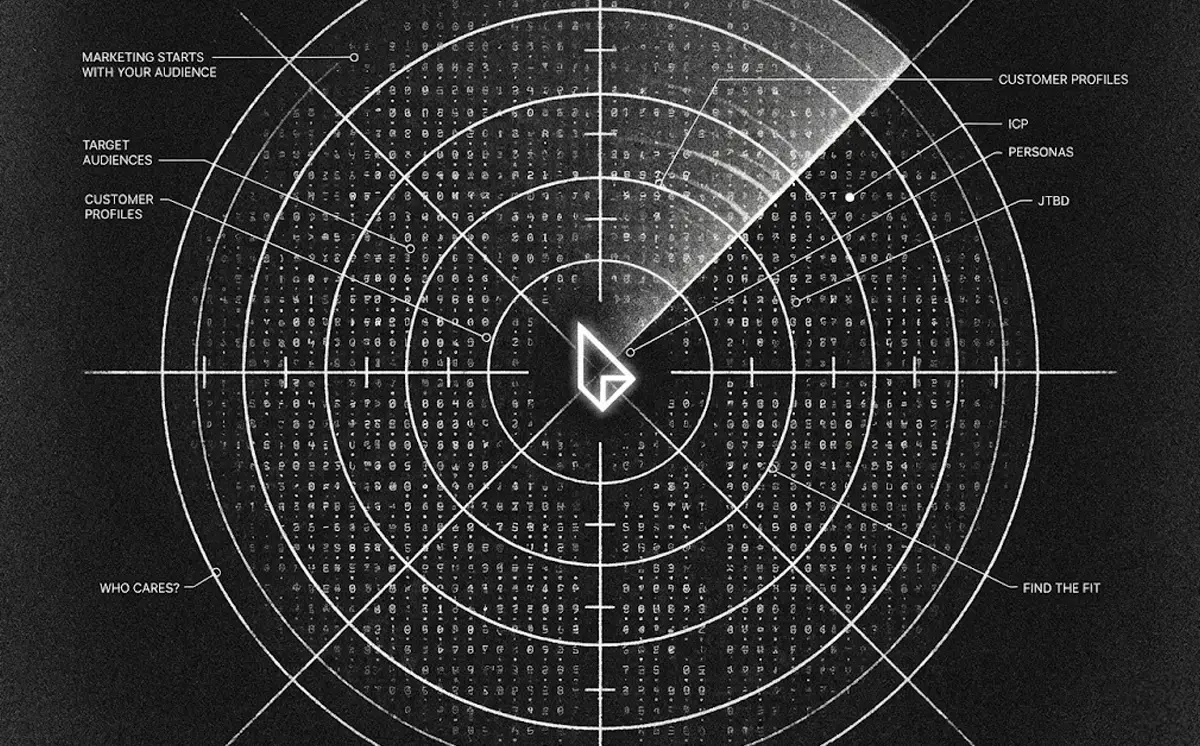
Marketing starts with your audience.
Whenever I’m stuck on a project and don’t know where to start or what’s next, I pause and remind myself: remember the audience.
Marketers (and creatives) (and executives) can get lost in our own bs. Our own buzzwords, KPIs and slide decks. We want our marketing and sales to be so successful that we can’t see the forest from the trees.
Our confidence gets focused on our spreadsheets in our quest to prove that, “This is going to work.” As if we just crunch the numbers hard enough, success will squeeze out.
But marketing isn’t like that. Answers aren’t in the numbers alone, but in the audience.
The core of building a successful marketing plan is understanding your audience.
What are they looking for? What problem do you solve for them? What happens if they don’t choose your business? What do they care about, personally and professionally?
Like most things in marketing, we have different terms for this same idea: Audience personas. Target audience. Target market. Ideal customer profile, or ICP. Jobs to be done, or JTBD. Market fit.
It doesn’t matter what you call it. It matters that you know it.
While each term is a little different in meaning, there’s so much overlap between them, and they all have the same purpose: to help marketers understand the audience’s mindset and what’s important to them during the buying cycle.
This, my friends, is critical, simple and so often overlooked. But if you don’t know your audience, you will struggle with marketing to them—and no plan in the world can save you.
If you know your audience, you can look at your plan and tactics and ask the million-dollar question: Who cares? Meaning, does your audience care about your offer/ad/email/website?
If not, what would need to change to get them to?
Asking “Who Cares?” is the simple method I use with our creative team to make sure our work is relevant to people and drive results for the business. Of course, this is marketing, where we need a special name and acronym. So another way to think about this approach is the WIIFM (What’s In It For Me) framework. Think about WIIFM as Who cares?—but in a suit.
Which leads us to one of my favorite components of marketing: positioning.
Brand positioning declares the fit between your business and your audience.
A hugely overlooked component of marketing is positioning. Positioning is a business’ declaration of expertise, customer promise, audience fit and core messaging, all rolled into one.
“We’re the B2B brand consulting firm businesses hire when they need to grow.”
“We’re the premium hotel for business travelers.”
“We’re the insurance company that protects business owners in risky industries.”
Positioning should be clear and concise, and it’s arguably the biggest asset you have in marketing.
Your position is your reputation. It’s what you want people to know you for.
Not all marketing teams have control over what the brand’s position is. But even if they don’t have a say in the direction, any good marketing plan uses positioning as its foundation, and marketing teams should do their best to define it clearly.
Messaging is built from positioning.
If positioning is the declaration of your expertise (or for B2C brands, the promise you make to your audience), the messaging is how you affirm that expertise. It’s what you say, and how you say it, in ads, brochures, videos, your website, recruitment materials, social media and even direct conversations.
It’s your tagline. Your headlines. Your calls to action. It’s the language that bridges the gap between where your audience is and where you’re going to take them.
Messaging often changes, at least slightly, across each expression of the brand. But the underlying goal, no matter where it shows up, is to remind the audience of the brand’s positioning. So that when they have a need, that they will recall your position.
Frequency, frequency, frequency.
After decades of working with hundreds of companies, my approach to marketing has been guided by a simple idea: Marketing is messaging and frequency.
Frequency refers to how many times, and how often, you’re connecting your audience, through ads, social media, blogs, speaking opportunities, PR, commercials, trade shows, etc.
In a lot of cases, the more touch points, the better. That’s easier said than done, because frequency requires spending.
Spending money, time and energy. You usually pay a cost to stay in front of your audience.
For example, in the B2B world, if you wanted a strong social media presence, you could: Write social posts and schedule them (requiring time, energy and expertise) or pay an agency to handle your social media and write on your behalf (requiring money.)
Both paths will give you the frequency you need, but their costs are entirely different.
Your spend, either money or energy, will limit your frequency.
Beyond that, your touch points usually have to be different to be effective. Delivering the same ad to someone too many times will just annoy them. That, or they start to ignore you. So it’s not enough to make a touchpoint once and then just bombard people with it—it’s an ongoing process.
The best way to determine your spend is to experiment.
“Well Mike, we want to 3x our leads in 2026. How much should we spend on social ads?”
I get that question a few times a month. It’s the magic question: how much of a return will I get back for my marketing spend? I don’t have the answer. And I think anyone that says they do—at least without having a deep understanding of your audience, ad competition, offer, sales process, and prior ad performance, might be feeding you a line.
Marketing is an art and science. It’s gambling. It is risk.
There is no magic framework to guarantee a return on your spend. The best way to figure out what works for you is to calculate the risk (how much you’re willing to lose) and roll up your sleeves and try. And again, the thing you’re risking doesn’t have to be money. Wasting your time writing, creating content, emailing your network—is also a risk.
The ROI might be nothing, but that doesn’t mean the tactic or channel is worthless. Your approach might be off by just a degree or two: your ad targeting audience needs a slight tweak. Your SEO strategy is missing a few gold keywords. Your social media posts need different visuals.
When you’re looking at planning your marketing—and the budget you’ll need to support it—start with your annual revenue. Most B2B firms spend between 5-10% of their total annual revenue on marketing, across all channels and tactics.
So for example, a company with less than $5M in annual revenue might budget $2,000–$5,000/month on SEO efforts and $1,000–$5,000/month on paid social. A B2B company with $30M+ revenue (or aggressive growth goals) might spend $20,000+/month on SEO and $20,000+/month paid social across multiple segments.
From there, you can determine what works for you, your internal resources (time) vs. external resources (cost) to determine your budgets.
Don’t waste your money—remember the funnel.
To be effective, your messaging and frequency needs to segmented to reflect where your audience is in the buying cycle.
Top of Funnel: Never heard of you.
Middle of Funnel: Aware of what you do.
Bottom of Funnel: Ready to buy today.
You want your messaging and tactics to align to this model. For example:
Top of Funnel: “Atomicdust helps B2B businesses grow.”
Middle of Funnel: “Check out this case study of how we helped the company scale.”
Bottom of Funnel: “Ready to build a brand people love? Contact us today.”
Digital ad platforms like LinkedIn can help you target you audience based on intent signals and serve specific messaging based on where they are in the funnel. When you’re planning your marketing and messaging, think of the where your audience will be in the buying cycle, and build multiple messages with the funnel in mind.
Campaigns and evergreen content: you need both.
Think of your efforts in two ways: campaigns and evergreen content.
Campaigns are your big pushes. New product launches. Pricing promotions. Rebrand announcements. They have a start and end date. They’re exciting, they get the team fired up, and honestly, they’re fun to work on.

Evergreen content is the stuff that works long-term. Your SEO-focused blog posts with information that will be relevant today and in ten years. Your case studies. Your “About Us” page that explains your positioning. This is the content that brings in leads at 2 am on a Tuesday.
Most businesses get obsessed with campaigns and ignore the evergreen stuff. Or they spend all their time on evergreen and never do anything exciting. You need both.
A good rule of thumb is to spend 70% of your efforts on evergreen, 30% on campaigns. The evergreen stuff compounds. The campaigns help you keep things fresh.
Here’s a LinkedIn post about a marketing automation I build that generates evergreen content from assets brands might already have on their website.
Marketing planning is good UX.
Famed designer Charles Eames said “The role of the designer is that of a very good, thoughtful host anticipating the needs of his guests.”
Your marketing plan should do the same. It’s easy to get over-focused on ads and conversion rates. But remember to use your plan as a way to delight and bring joy to customers.
Some of the best marketing doesn’t feel like marketing at all. It feels like the business gets you and guides you.
A coworker had a rough day a while back and stopped at Trader Joe’s on her way home. The cashier asked how she was doing, and she probably overshared. Next thing she knew, the cashier handed her a bouquet of flowers and wished her a better tomorrow. Turns out, this is just what they do. It’s company policy to give away flowers that are past their prime to customers who need them.
That’s brilliant marketing. Zero ad spend. But every time someone mentions Trader Joe’s, she tells that story. That’s what I mean by planning to delight customers.
“But Mike, I’m in the plumbing supply business and this is ridiculous. Our customers will never love our brand. We just need sales.” Listen, it doesn’t take that much more effort to make an otherwise ordinary experience memorable.
Little things like knowing your client’s name, knowing where they’re coming from and what they’re trying to do can make all the difference in the world.
And if you’re going to plan, you might as well plan to delight your customers.
The work versus the spreadsheet.
“Everyone has a plan until they get punched in the face.” -Mike Tyson
Planning your marketing for an entire year, down to the tiny details, might prove to be frustrating—or even a waste of time. Because you never know what is going to happen.
My advice? Plan the structure. Plan the evergreen. Understand your foundational pieces like audience, positioning, and messaging. Start experimenting with a couple tactics. And then, to an extent, play it by ear.
See what happens in your industry, world events, technology. Use your campaigns as 90-day experiments and track performance. Pay attention to a couple of metrics, like leads and close rates, and think of new ways to impact them compared to the previous quarter.
Marketing isn’t done on a spreadsheet. Let your market be your guide, and then go shape it.
FAQ: Marketing Planning for 2026
What should be included in a marketing plan?
How much should I budget for marketing?
What’s the difference between campaigns and evergreen content?
How long should a marketing plan be?
Do I really need a marketing plan?
How do I know if my marketing is working?
Need help figuring this out?
Look, I get it. Reading a blog post about marketing planning and actually building a marketing plan are two very different things.
If you’re sitting there thinking, “This makes sense but I have no idea where to start,” that’s normal. A lot of companies struggle with this stuff because they’re too close to their own business to see it objectively.
That’s literally what we do at Atomicdust. We help B2B businesses figure out their positioning, nail their messaging and build marketing that’s effective.
If you want to talk through your 2026 marketing plan, or if you just want to gut-check what you’re already doing, reach out. We’ve been doing this for 25 years and we’re pretty good at cutting through the noise.