Back in 2016, we published a guide called Content Marketing: A Guide for Healthcare Marketing Managers. It told you to know your brand, know your audience, blog consistently and share everything on Facebook and Twitter.
Most of that advice built a decade of healthcare marketing. Some of it now reads like a time capsule. (Twitter posts were 140 characters. We checked.)
So we rewrote the whole thing for 2026. Here’s what changed—and what stubbornly didn’t.
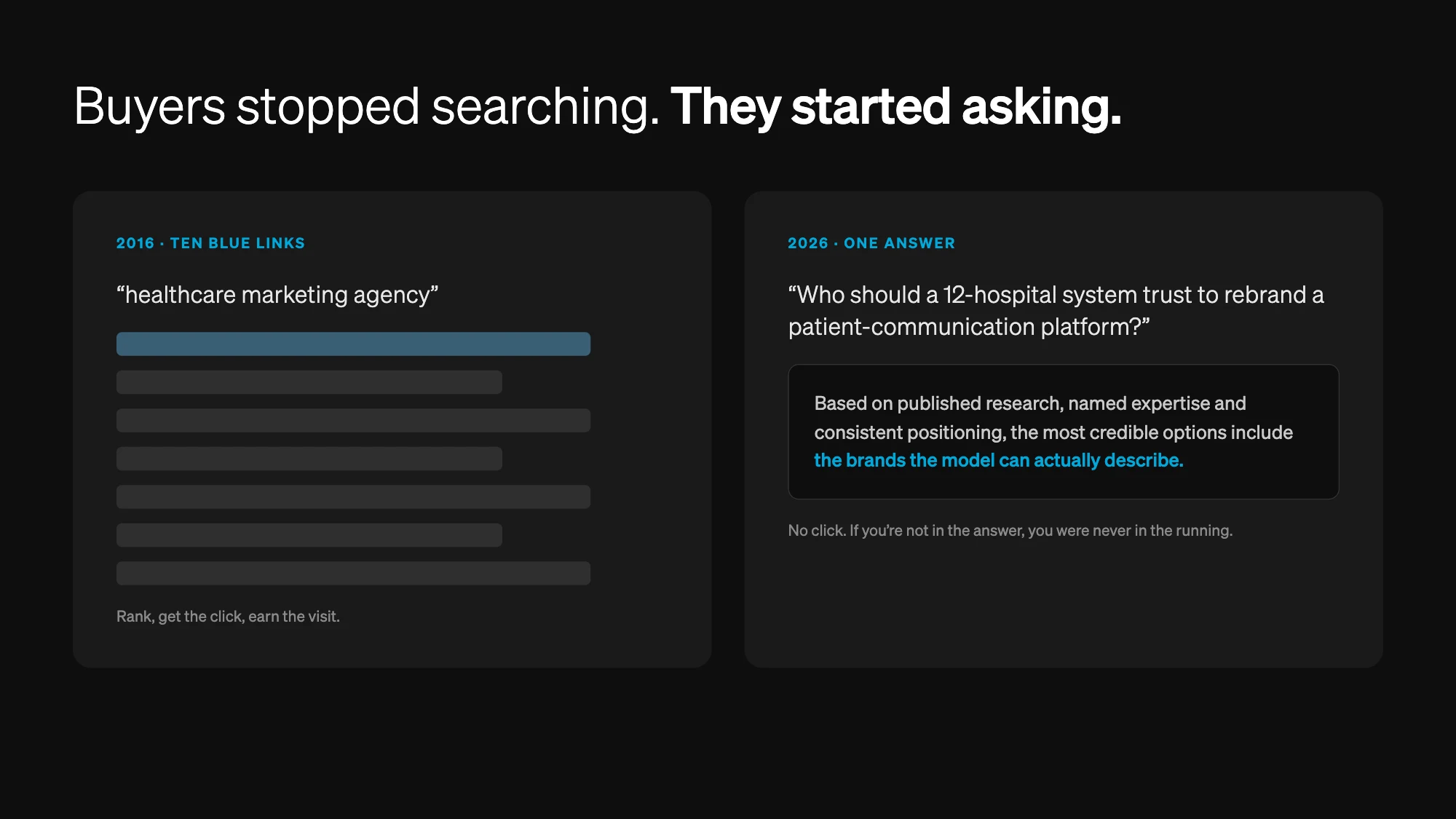
Your buyers stopped searching. They started asking.
The CMIO evaluating a platform. The hospital exec comparing vendors. The practice manager with a billing problem. More and more, they don’t browse ten blue links—they ask ChatGPT, Claude, Perplexity or Google’s AI Overviews a full question and read one synthesized answer.
Most of those answers happen without a click. If your expertise isn’t in the answer, you were never in the running. And you’ll never see it in your traffic reports.
Here’s the good news: those answer engines learned everything they know from content. Someone’s content. The clearest, most credible expertise in your category is what gets retrieved, cited and repeated. Content marketing isn’t dead—it’s the raw material of the new search.
Every piece of content now has two readers
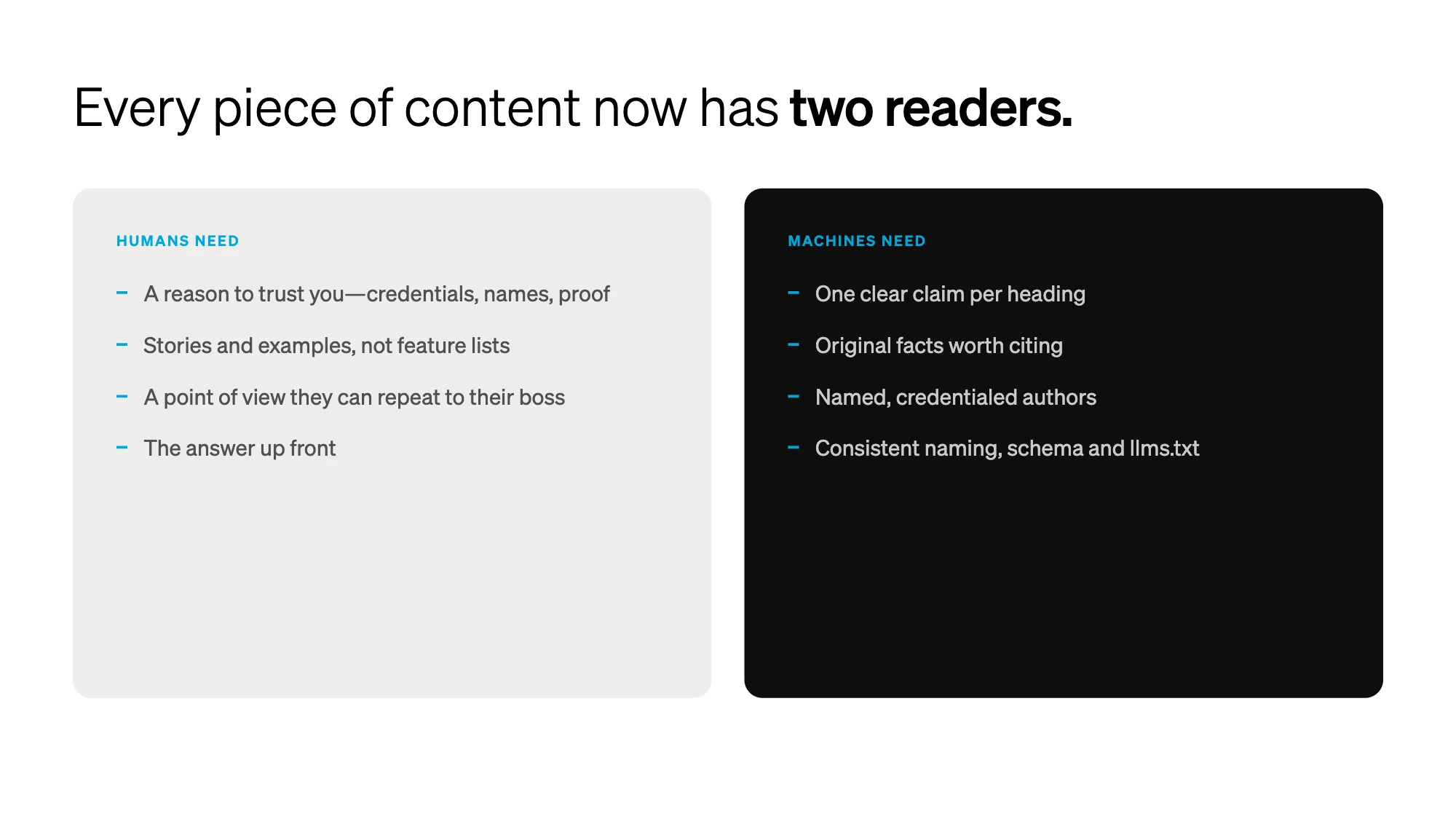
A human and the machine reading on their behalf. Humans need trust, stories and a point of view they can repeat to their boss. Machines need structure, original facts, named authors and consistency.
The overlap is the strategy: clarity, structure and proof serve both. Nothing that makes content retrievable makes it worse for people.
What still works
Some advice survives every platform shift:
- Start with a goal. Leads, awareness, loyalty or sales support—pick one primary goal per quarter. Content that serves everything serves nothing.
- Know your brand first. When an AI compresses every vendor to a sentence, interchangeable positioning makes you invisible. “Patient-centered solutions” describes everyone, so it retrieves no one. (Curious how yours reads? Run the free healthcare brand audit.)
- Email is still king. The newsletter is the one channel no algorithm can take from you.
- LinkedIn works through people. Company pages announce. Your clinicians and leaders posting in their own voices persuade.
What’s new in the 2026 edition
- GEO—how answer engines pick their sources, and why healthcare’s high stakes make credentials count double
- Using AI without losing your voice—house rules for healthcare teams, including clinical review and keeping PHI out of prompts
- Structure as the new SEO—answer-first writing, schema, llms.txt and credentialed authors
- Automation—wiring your CMS, CRM and social together, with AI coworkers doing production work and a named expert always at the approval gate
- Measuring influence, not just clicks—because your influence can grow while your traffic falls
One exercise to try this week
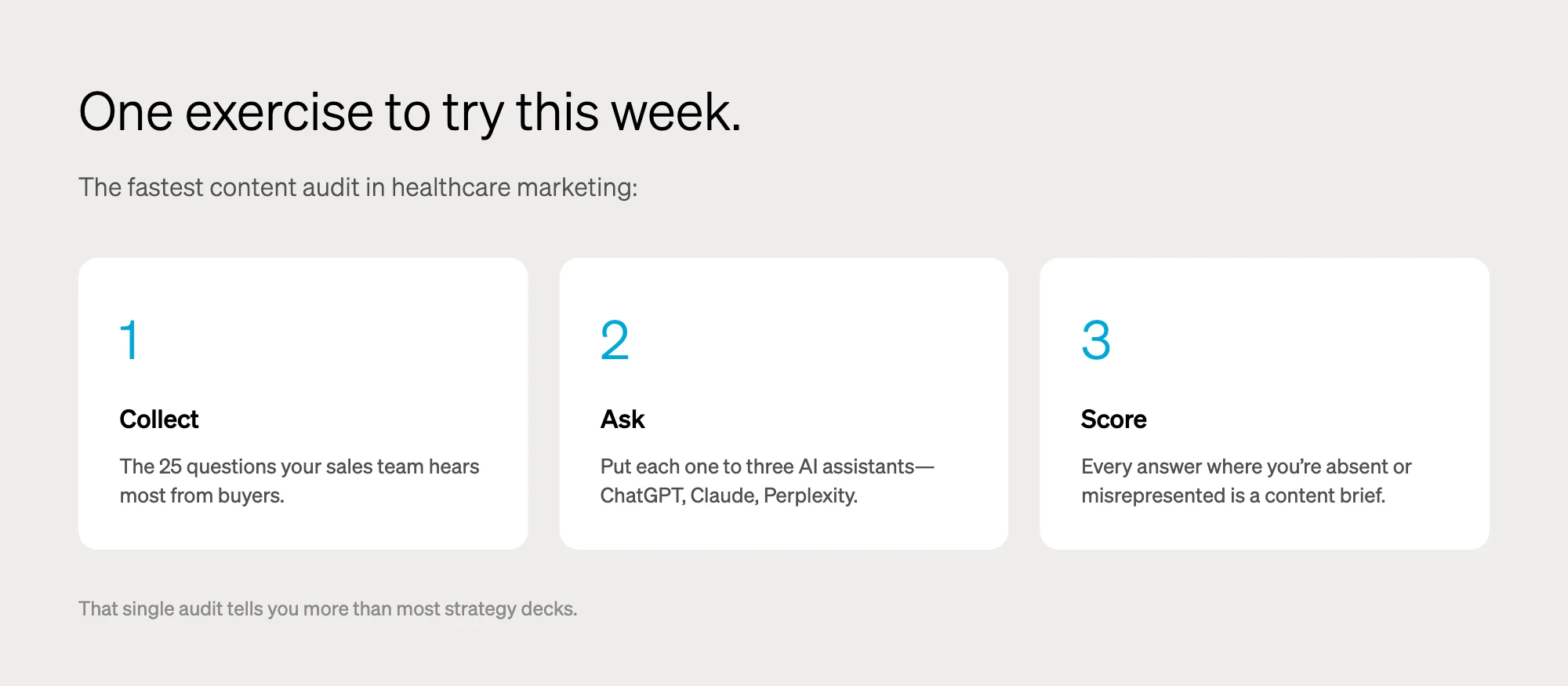
Collect the 25 questions your sales team hears most. Ask three AI assistants each one. Every answer where you’re absent or misrepresented is a content brief.
That single audit tells you more about your content priorities than most strategy decks.
Get the full guide
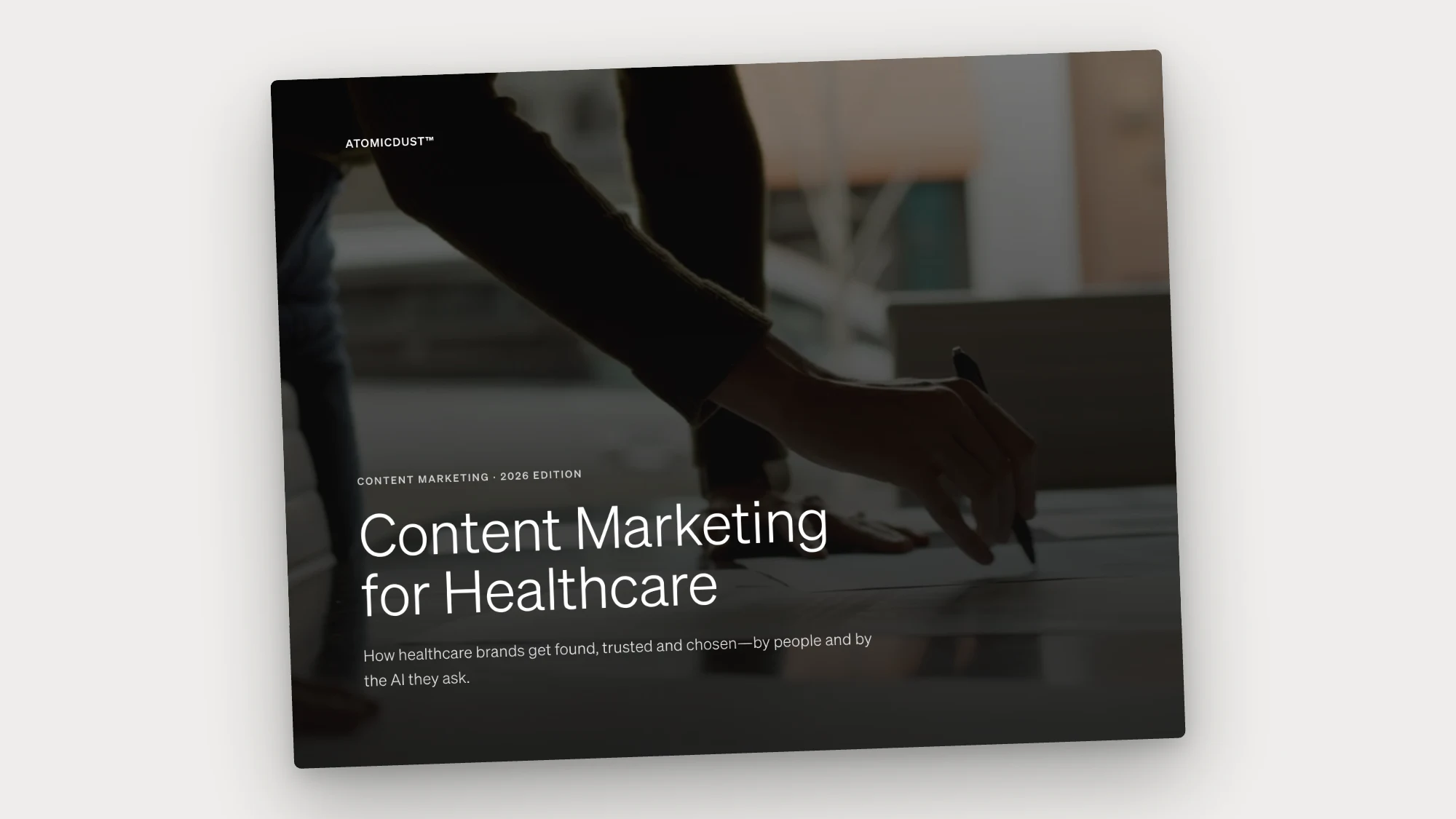
The 2026 edition is 19 pages: goals, GEO, the channel playbook, the strategy FAQ, automation and a 10-point checklist you can score yourself against today.
Download Content Marketing for Healthcare—the 2026 edition. It’s free, and we’ll only email you things worth reading.